How we trend-jacked the KitKat Heist in 35 minutes with AI
Last week, 413,793 KitKats were stolen from a warehouse. I have no information about the whereabouts of the third truck.
But I did spend a Friday night with Ben, a bag of contraband chocolate, and a live audience, trying to answer an important question: can any brand react to a viral moment in real time, stay completely on brand, and produce something actually worth posting. Or is that still the kind of thing that only the best-resourced marketing teams can pull off?
Here's what we found out.
The brands that won the KitKat news cycle
When the heist broke, a handful of brands moved fast:
- Ryanair posted one of their planes with its mouth stuffed full of KitKats. Very them.
- Microsoft Edge did a fake urgent internal email about KitKats
- World of Warcraft turned it into an in-game quest in their own brand universe
- Pizza Hut implied they might have benefited from the whole situation
- Durex produced a chocolatey product concept I'll leave to your imagination
The brands that landed it didn't sound like KitKat. They sounded like themselves. Ryanair's version was funny because it was exactly what the unhinged brand would say.
The ones that felt a little forced (and there were a few), were the ones where you could feel the brand straining to be relevant rather than just being themselves and letting the moment do the work.
Why most brands miss the window
There are two ways to lose at trend-jacking:
- The first is speed. Most brands, by the time they've got internal alignment, briefed the tool, waited for the output, reviewed it, revised it, and got sign-off, the moment has passed. The internet has moved on. The window was maybe 48 hours and you spent 72 getting the asset approved.
- The second is brand. You move fast, you get something out but it doesn't sound like you. It sounds like a brand trying to be funny. The copy is slightly off. The visual is generic. Anyone could have made it. And now instead of owning the moment, you've just added noise to it.
These two problems feel like they're in tension with each other. Move fast and you sacrifice brand coherence. Take the time to get the brand right and you miss the window.
That's the problem we built SecretSauce to solve. And on Friday night, we decided to show rather than tell.
What we decided to do on a Friday night
The brief Ben put together was deliberately crude. He wanted to show what SecretSauce could do with a rough, unpolished input. The kind of thing anyone could write in 30 seconds without a strategy deck or a creative director in the room.
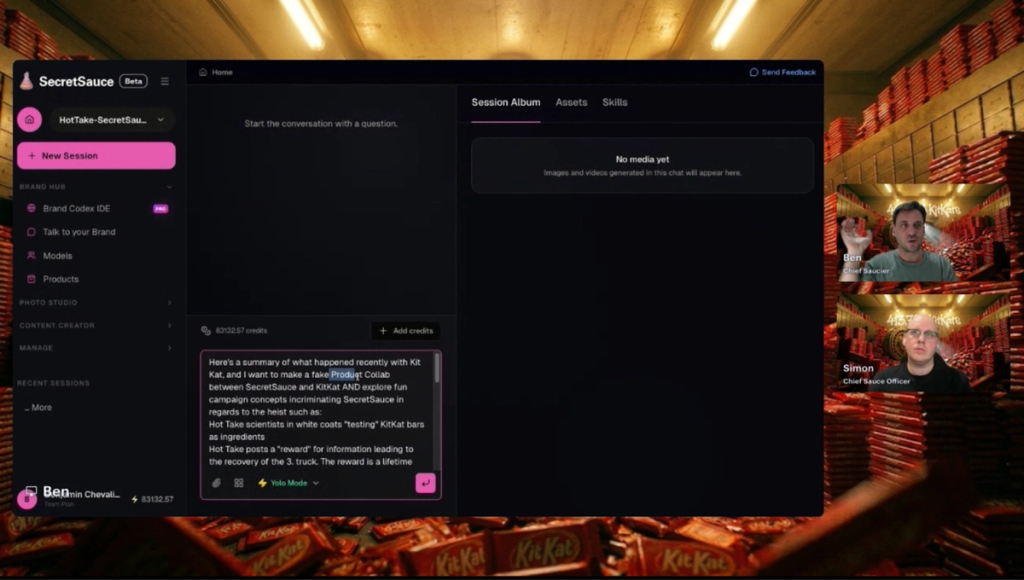
The setup: using our demo brand Hot Take, which we built as a creative playground inside SecretSauce, complete with flavors, visual assets, and AI avatars.
The angle: implicating Hot Take in the heist. Ben seeded a few directions: scientists in white coats testing KitKat ingredients, a wanted poster, security footage of a KitKat truck, an official statement. He dropped in a URL to a KitKat heist meme article for context, a few visual references, and then he let SecretSauce go.
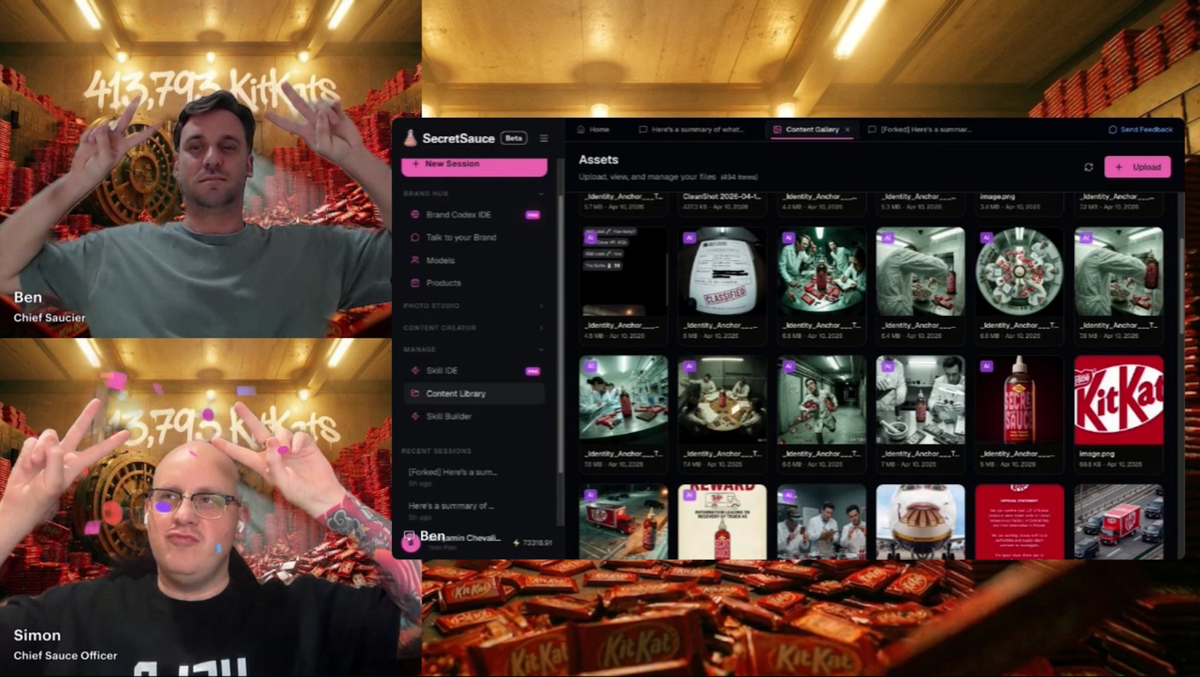
While Ben was pasting in his rough brief, SecretSauce was simultaneously reading the heist article, reading the KitKat brand codex, and reading the Hot Take brand codex. By the time the first output arrived, it already knew what KitKat sounds like, what Hot Take sounds like, and what the joke was supposed to be. Ben didn't have to explain any of that.
What SecretSauce generated in a few minutes
A lot came out of that session, but 3 concepts are worth calling out specifically:
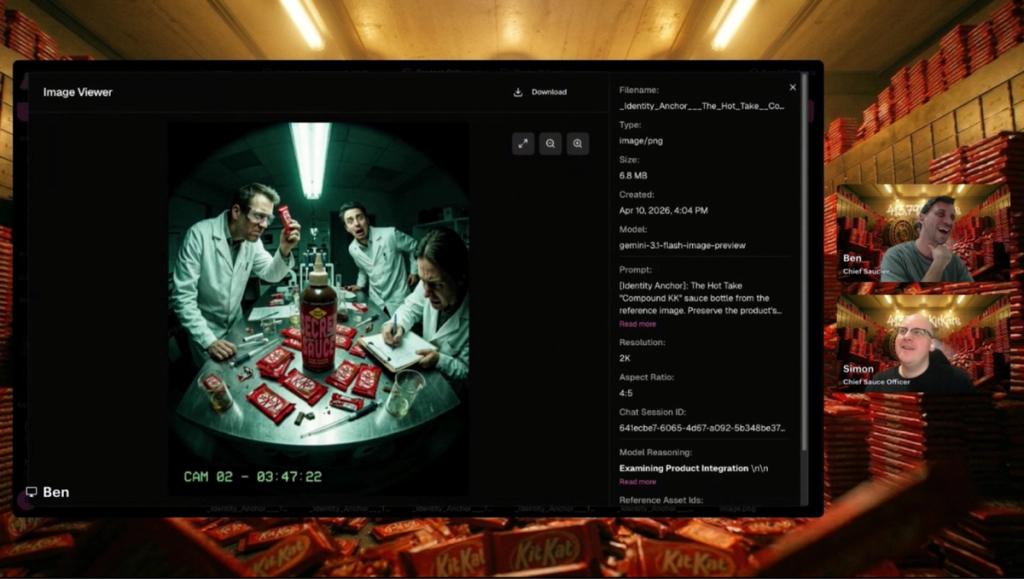
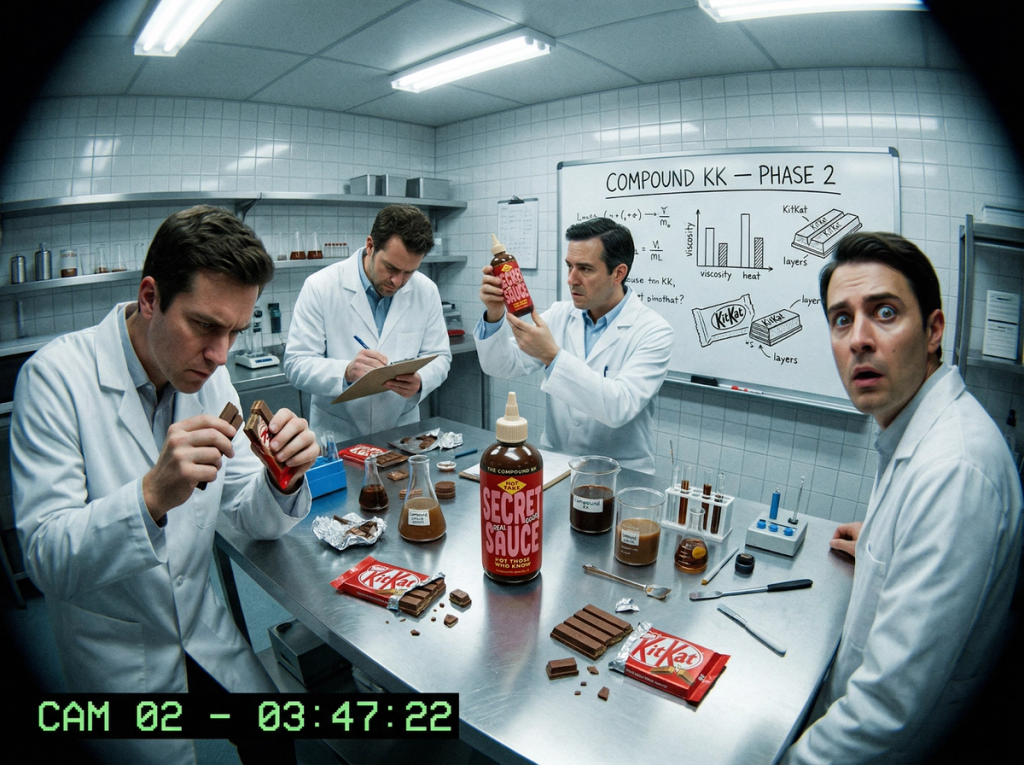
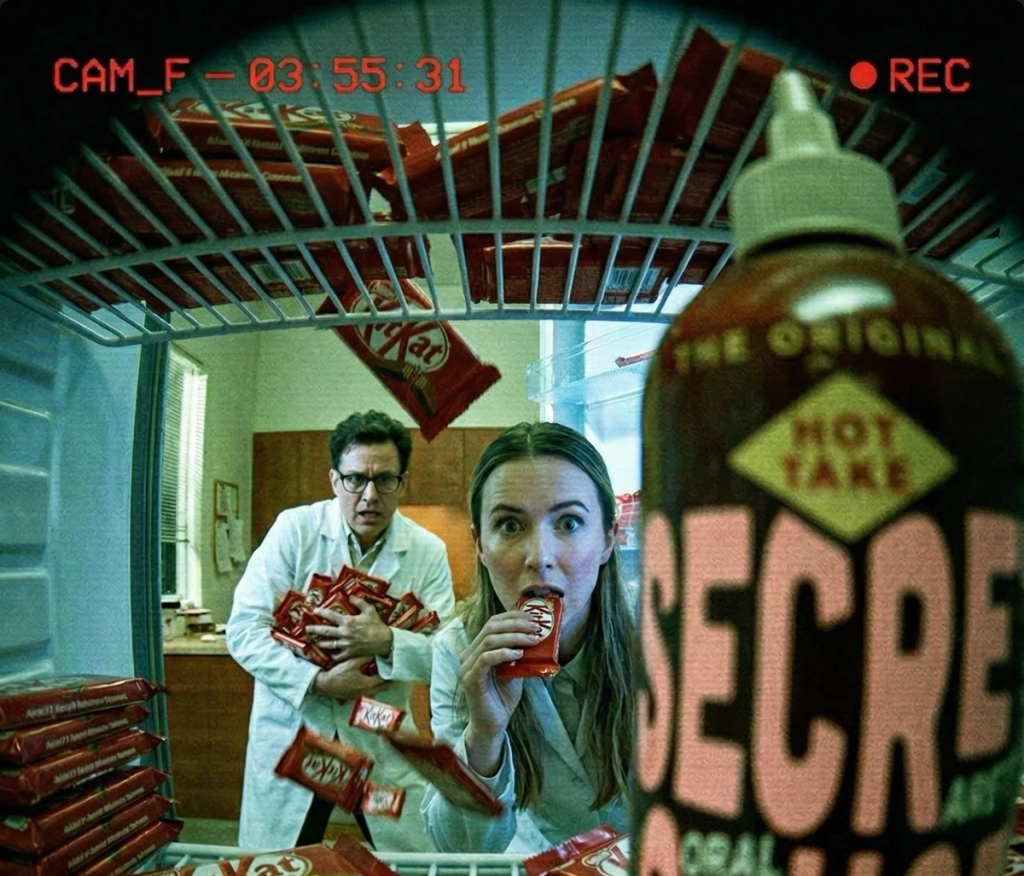
The scientists. A lab scene, white coats, a fridge overflowing with stolen KitKats, Hot Take sauce bottles on the shelves behind them.
What stopped me was the detail: flavor compounds in the background, the text on the scientists’ clipboards that said “KitKat wafer density analysis,” the colors of the liquids in the lab matched the colors of the KitKat bars.
Ben didn’t ask for any of that. SecretSauce put it there because it understood the world it was building. I said on stream: "It's a pretty crazy level of detail." Ben pointed out that SecretSauce was "greedy,” going further than the brief asked for because it had enough context to know what further looked like.
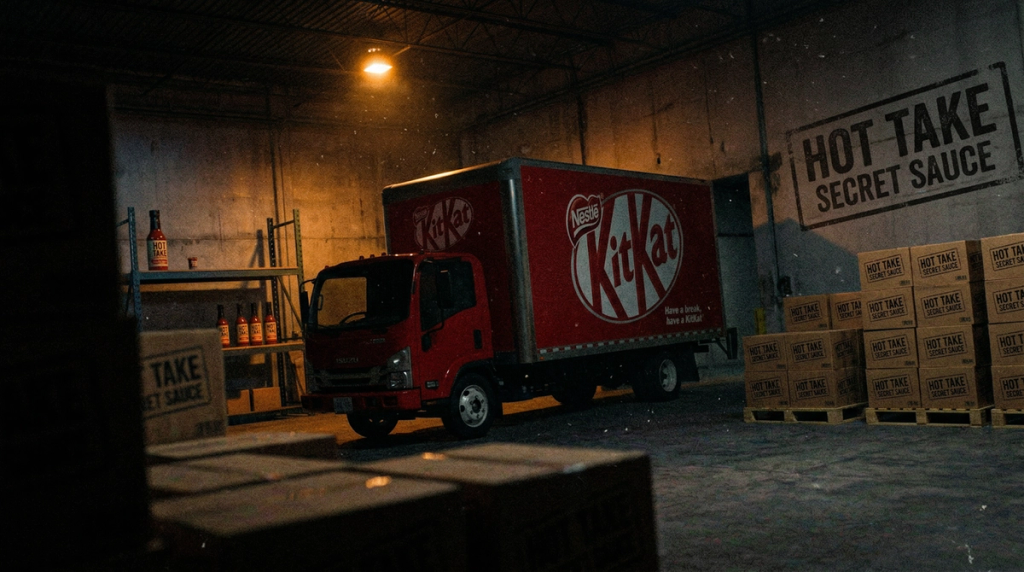
The hangar. Ben described what he was going for: "Someone who's passed by and just noticed that wait a minute, there is a KitKat truck inside that hot take hangar that shouldn't be the case. I'm gonna notify the authorities." Low quality mobile phone photo, bad lighting, shot like evidence.
What came back had giant Hot Take bottles visible in the background, placed there without being asked. KitKat branding on the truck, correct. Both brands, in the same frame, both intact. That's actually the harder thing to do. Most tools, given a brief like that, would have drifted toward one or lost both. SecretSauce kept them because it understood it was telling a story that belonged to two brands at once, and it knew what both of them looked like.
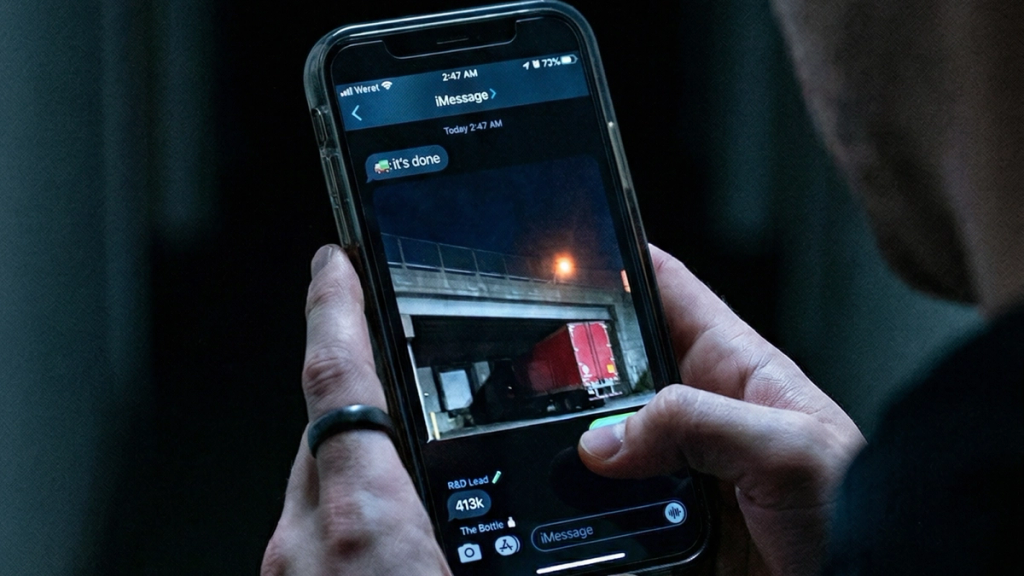
A text message exchange. This one SecretSauce came up with itself. A truck driver texting "it's done," the reply "how many," and then a photo of the truck. 413,000. Ben iterated on it and asked for an over-the-shoulder version, someone watching the exchange happen, which pushed it into full heist movie territory. I described the vibe on stream as "The Hangover meets science heist."
The question I asked Ben on camera
About halfway through the stream, I asked Ben a question I'd been sitting on: "Why wouldn't you just do this in ChatGPT or Gemini or one of the LLMs? Why would you use something like SecretSauce for this?"
His answer was the clearest version of the SecretSauce pitch I've heard him give: "SecretSauce has an understanding of your brand, an understanding of more broadly everything that it needs to know to create good looking content. And then it remembers what you've been talking about in the thread. In Gemini, I'd have to copy paste constantly the same prompts, the same images, the same references, and everything."
The difference isn't the image model. It's that when you open SecretSauce, your brand already exists. The tone of voice is there. The visual identity is there. The context from everything you've already made is there. Ben didn't have to remind the agent which sauce bottle to use, or what register to write in, or that this was supposed to be funny. It already knew. Every "make it more unhinged" landed in the right place because the foundation was already set before he typed a single word.
In any other tool, you're starting from zero every time. Here, you're already halfway there before the brief is written.
What this means for any brand that wants to show up when the moment is live
The KitKat Heist was one trend. There will be another one next week, and the week after: a news story, a cultural hook, a meme that breaks through, a product launch from another brand that hands you an opportunity.
These windows open and close fast, and the brands that consistently own them are not the ones with the fastest designers or the biggest teams. They're the ones who've done the upfront work and prepared AI well enough that when the moment arrives, all they have to do is point and shoot.
The question of whether reactive marketing can be both fast and on brand? The answer is yes.
If you want to be the brand reacting instead of watching, you can try SecretSauce at trysecretsauce.ai.