How to stage a vacant property without paying a stager
Turn photos of your empty rooms into warm, furnished shots buyers can picture themselves in: clean staged photos for your listing portal, plus a before-and-after carousel for Facebook and Instagram.
Have a photo of each empty room you want staged, shot in daylight with the whole room in frame: upload them, or @mention the asset card if the listing's photos are already saved in SecretSauce. Check your MLS's rules on labeling virtually staged photos before you post.
How it works
1
Plan the staging
Pick a furniture style that suits the property's architecture and the buyers most likely to tour it, like transitional for a broad-appeal suburban home, mid-century modern for a 1960s ranch, modern minimal for a new-build condo, Scandinavian for small or low-light rooms, or coastal for waterfront. Map which room photo gets staged and what each room's purpose will be.
2
Stage each room
Work from your own photo of each space, adding removable furniture, rugs, lighting, art, and greenery while keeping the walls, windows, flooring, and fixtures exactly as shot. Skip any room you have no photo of rather than inventing it.
3
Keep a clean set for the listing
Hold back an unbranded version of every staged room at the ratio the original photos came in, with no captions or social framing, so it's ready for the MLS, a listing portal, a brochure, or a buyer email.
Assemble the same staged rooms into a before-and-after carousel with /socialCarousel at 4:5 portrait, leading with the strongest staged room and pairing each empty shot with its staged version.
5
Write the caption
Open on the detail buyers care about most, cover the specs that qualify a lead, close with a clear CTA to book a viewing, and note in the text that the photos are virtually staged.
Furniture is what makes a listing photo work. It tells a buyer where the bed goes, how much room is left to walk around it, and what kind of life fits in the space. That's why staged listings photograph so much better than empty ones: the buyer gets a scale reference and a story in the same frame.
Virtual staging gets you both from the photos you already took. The room stays exactly as it is and the furniture goes in digitally, so a whole listing can be staged in the time it takes to write the MLS description. You come away with 2 sets: clean staged photos for the listing portal and buyer emails, and a before-and-after carousel for social.
Why empty rooms are hard to sell, and why stagers cost so much
Empty rooms are hard to sell online because a photo strips out every cue a buyer uses to judge size. Standing in a vacant room, you've got your own body for scale. In a photo you've got nothing, and the wide-angle lens most listing shots are taken with pushes the walls out and flattens the depth, so the room reads smaller and colder than it is.
Furniture fixes that 3 ways. First, a sofa and a coffee table are objects buyers already know the size of, so the room becomes measurable. Second, staging assigns a purpose to ambiguous space: an awkward bump-out becomes a reading nook, an odd 8-foot wall becomes a desk. Third, it sets an emotional temperature, which is what makes someone stop instead of swiping past another bare white box.
Stagers cost so much because you're renting furniture, not buying a service. A staging company charges a consultation fee, then delivery and installation, then monthly rental on every piece until the house closes, and a vacant listing needs whole rooms furnished rather than a few accent pieces. On a vacant property that bill usually lands on the agent, and it keeps running for as long as the listing sits, which is exactly when cash is tightest. That's why so many vacant listings go to market with bare photos: the math only works on the homes where the commission is big enough to absorb it.
What good virtual staging looks like
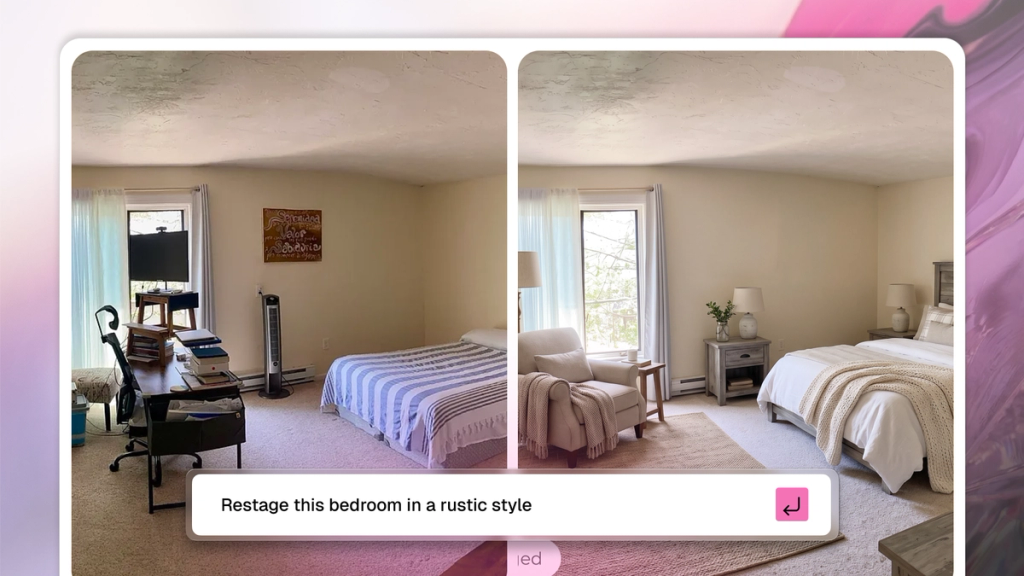
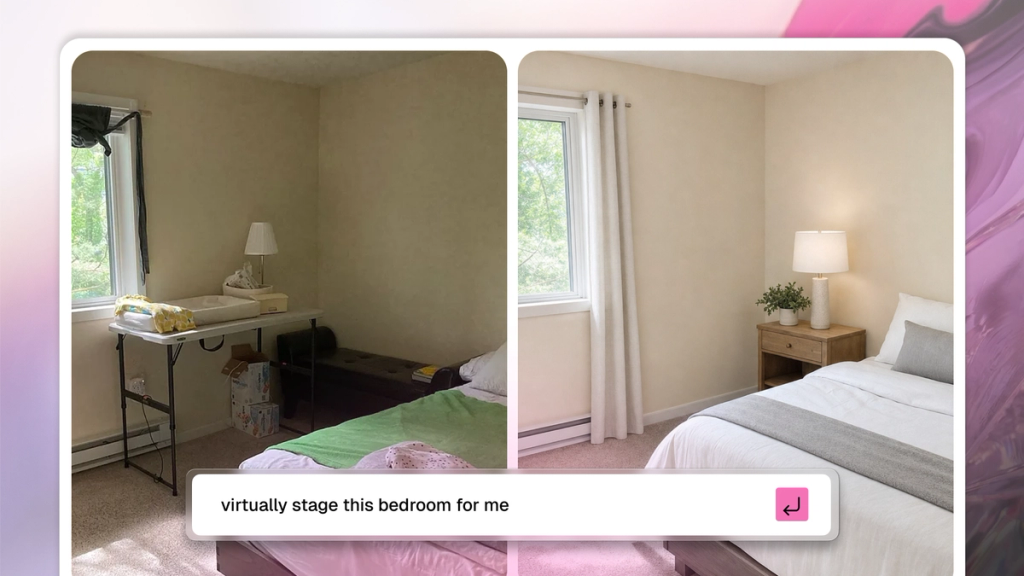
Good virtual staging looks like a room a buyer could move into next month, furnished the way a real person would furnish it. The test is whether someone who walks the property recognizes it from the photo. If they're surprised at the door, the staging went too far.
The architecture stays untouched: walls, windows, flooring, trim, countertops, and fixtures come through exactly as photographed. Staging only adds what a moving truck could carry back out.
Scale stays honest: put a queen bed in a room that fits a queen bed. Shrinking furniture to make a room look bigger is the fastest way to lose a buyer's trust in person.
The style matches the house: mid-century pieces in a 1960s ranch, soft transitional furniture in a suburban colonial, and clean minimal pieces in a new-build condo.
One palette runs through the set: the rooms should read as one home, so repeat 2 or 3 accent colors across every shot rather than styling each room in isolation.
Rooms stay under-furnished: a bed, 2 nightstands, a rug, and one piece of art beats a full catalog. Open floor is part of what buyers are shopping for.
Light matches the photo: if the original frame has afternoon sun coming from the left, every shadow under the staged furniture falls to the right.
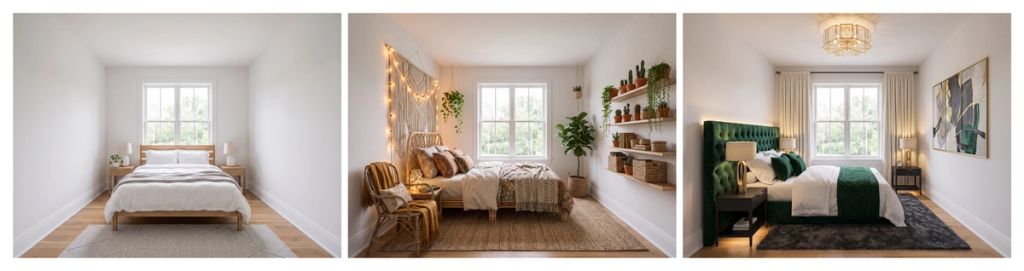
Which staging style to choose
The right staging style is the one that matches the architecture and the buyer most likely to tour the house, because furniture that argues with the building reads as fake even when the render is perfect. These are the directions that carry most listings:
Transitional: the broad-appeal default for suburban family homes. Soft neutrals and simple shapes that read as tasteful to almost everyone, which is what you want when the buyer pool is wide.
Modern minimal: new-build condos, lofts, and anything with clean lines and big glass. Few pieces, low profiles, and open floor.
Mid-century modern: 1950s and 1960s ranches, split-levels, and post-and-beam homes. Walnut, tapered legs, and warm accents that flatter the original architecture.
Scandinavian: small rooms and low-light spaces. Pale wood, light textiles, and airy arrangements that keep a tight room from feeling tighter.
Coastal: waterfront, lakefront, and warm-climate homes. Whites, blues, natural textures, and furniture that suggests the view is the point.
Farmhouse or traditional: older homes, rural properties, and anything with original woodwork. Warmer woods and classic silhouettes that suit the bones of the house.
Luxury contemporary: the top of your local market. Statement pieces, layered lighting, and art that signals the price point.
If you're torn, stage one room in 2 directions and compare before committing the rest of the house.
Keeping virtually staged photos honest
Virtually staged photos stay honest when the buyer knows they're looking at furniture that isn't in the house. NAR's Code of Ethics requires a true picture in advertising, and many MLSs carry their own rules on disclosing materially altered images, so check what yours asks for before the photos go anywhere.
A "Virtually staged" label is standard practice: a small tag in a lower corner stays with the photo when it gets screenshotted, shared, or pulled into another site, which is why portals ask for it. The staged files come back clean, so adding one is yours to do before you upload.
Say it in the caption too: one short line is plenty, and it reads as confidence rather than as a disclaimer.
Never change what's permanent: don't remove a wall, swap the flooring, resurface a counter, hide a radiator, or tidy up the view out the window. Those are the edits that turn a showing into a complaint.
Keep the empty original in the set: pairing before with after is the disclosure and the most engaging thing you can post, in one move.
Leave people out of the frame: staged rooms with no models keep the focus on the space and keep your advertising clear of fair housing trouble.
9 ways to post a virtually staged listing on social media
The before-and-after swipe: slide 1 empty, slide 2 staged. The transformation is the hook, and the pairing discloses the staging by itself. Caption: "Slide 1 is how this 3 bed sits today. Slide 2 is what it holds. 1,420 sq ft in [neighborhood], open Saturday."
One room, 3 ways: stage the same bonus room as a home office, a nursery, and a guest room. It answers the question every buyer asks about flexible space. Caption: "This room can't decide what it wants to be. Office, nursery, or guest suite: swipe and pick yours."
The full walkthrough: order the staged rooms the way a buyer moves through the house, front door to backyard. Caption: "A walkthrough of [address], door to deck. Which room would you claim first?"
The awkward space rescue: stage the odd corner, the landing, or the space under the stairs. It's the objection you field at every showing, answered before anyone asks. Caption: "Every house has one weird corner. Here's what this one is good for."
Furnished for the buyer you want: stage a downsizer's condo like a downsizer lives there and a family home like a family does. Caption: "Staged for the way this house gets lived in: [detail], [detail], and a kitchen that seats 6."
The dimension overlay: put each room's measurements on the staged photo so the scale is explicit instead of implied. Caption: "14 by 16, with a king, 2 nightstands, and room to walk around all of it."
The style poll: post 2 staging directions for one room and let the comments decide. It's cheap engagement, and it tells you what your local market responds to. Caption: "Warm and traditional, or clean and modern? Same living room, 2 directions. Which one sells this house?"
The restage repost: a listing that's been sitting looks new again in a different staging style, especially alongside a price change. Caption: "Fresh look and a new number on [address]. 4 bed, 2.5 bath, ready now."
The just-sold proof post: pair the staged photo with the sold banner. It's the post that wins your next listing appointment, because it shows sellers what your marketing does. Caption: "Vacant when I listed it, staged the same week, under contract in [X] days. [address]."
How often to post while a listing is live
A good cadence for a live listing is 2 to 3 posts a week for that property, enough to stay in front of local buyers without turning your feed into a billboard. Launch with the before-and-after image carousel in the first 48 hours while the listing is newest, then post a single staged room mid-week answering one thing buyers keep asking about. Before an open house, put a staged room in Stories with the time and address and add the location sticker so it surfaces to nearby accounts.
Reels reach far more non-followers than static posts, which is why they carry discovery for a local audience. If you want one for the same listing, a property flythrough can be built from these same photos. From there the platform side is yours: schedule the set, and if you're putting spend behind it, run it as a housing ad under Meta's Special Ad Category, which restricts targeting for fair housing compliance.
How to stage a full listing with SecretSauce in 15 minutes
Bring in your room photos: upload the vacant shots, or @mention the asset card if the listing's photos are already saved. One wide, well-lit frame per room is all it takes.
Choose your staging style: name the direction you want, like transitional, modern minimal, mid-century modern, Scandinavian, coastal, farmhouse, or luxury contemporary. If you're not sure, ask for the same room in 2 styles and pick from the pair.
Get one plan for the whole listing: SecretSauce reads the architecture in your photos and proposes the palette and a purpose for each room, so the set reads as one home instead of 9 separately decorated pictures.
Stage each room from its own photo: the furniture, rugs, lighting, and greenery go into your real room, with the walls, windows, and finishes left exactly as shot.
Take the clean photo set: the staged after-images come back unbranded, at the ratio your listing photos came in, ready to upload to the MLS or a portal, drop into a brochure, or send straight to a buyer.
Take the social set too:/socialCarousel packages the same staged rooms into a before-and-after carousel at 4:5 portrait, the ratio that takes the most screen on a phone and cross-posts cleanly from Instagram to Facebook.
Get the caption with it: the post copy comes back in your voice with the specs that qualify a lead, a CTA to book a showing, and the staging noted in the text.
Why this beats hiring a stager
This beats hiring a stager because it runs on the photos you already have, on the day you win the listing, and it gives you both deliverables at once. Nothing gets delivered, installed, or picked up, so there's no window to schedule around and nothing to haul back out when the house closes. Staging 9 rooms costs what staging 1 does, you can restage in a different style when the listing goes quiet, and the same set covers the portal and the feed. The furniture still has to be honest, and the buyer still walks into an empty house. What you're buying is the thing that gets them to book the showing at all.