Compare AI voiceover options in UGC video tools (It's the script, not just the voice)
If you play an AI UGC ad with the sound on, you can usually tell it's AI within the first few seconds. Likely, because it contains lines no one would really say out loud, like "Game changer. Seriously.", in a voice that's either too monotone or too enthusiastic.
When marketers compare AI voiceover options in UGC video tools, they tend to start by auditioning the available voices, since the voice is easiest to blame when an ad sounds robotic. But swapping voices rarely fixes the ad. The AI voice reads the script it's given, and most of what makes AI UGC sound like AI is written into that script: fragments that don't connect, one emotion on every line, sentences built for a slide instead of a mouth.
Ideally, you want to choose a UGC video tool that generates a natural sounding script in a natural sounding voice.
AI voiceover options in UGC video tools: Quick comparison
You have 3 ways to voice an AI UGC ad: a generic AI voice from the video tool, a clone of a real person's voice, or a person recording it. They differ most in how human they sound and in what it costs you every time the script changes.
| Generic AI voice | Voice clone | Recorded human voiceover | |
|---|---|---|---|
| How often listeners labeled it human (PLOS One, 2025) | 41% and 39% of trials | 58% and 70% of trials | 62% to 81% of trials, depending on the experiment |
| What a script change costs you | Edit the text and regenerate | Edit the text and regenerate | A new recording |
| Whose voice it is | A stock voice the tool provides | Yours, or your spokesperson's | Whoever you book |
| Same voice across a batch of ads | Yes | Yes | Only if the same person records every one |
| Best for | Testing formats fast | A founder or spokesperson read, at volume | A hero ad that runs for months |
The numbers come from a 2025 study published in PLOS One, in which listeners heard short voice clips and judged whether each one was a person or AI. Even real voices weren't labeled human every time. Listeners called them human in 62% to 81% of trials, depending on the experiment, and the authors put that spread down to context. For a marketer, it's important to note how far apart a generic voice and a clone landed in the same test. In the second experiment, listeners labeled clones human in 70% of trials, close to the 72% for real voices, and labeled generic AI voices human in only 39%.
What is a generic AI voice?
A generic AI voice is a stock synthetic voice that a video tool offers out of the box, built to read any text you give it. You pick one by gender, accent, and age range, type the script, and the tool generates the read.
Advantages of a generic AI voice
- Speed: You can generate multiple voiceovers in minutes, as fast as it takes the AI to generate
- No talent to manage: You don't have to get into the logistics of booking, briefing, and paying voiceover artists or creators
- Range: You can easily test different accents or ages for each audience you're targeting
Disadvantages of a generic AI voice
- Less human to listeners: In the second PLOS One experiment, listeners labeled generic voices human in 39% of trials, against 70% for clones
- It's everywhere: The same stock voice can turn up in a competitor's ads, so it never becomes your brand's voice
- No instinct for pace or emotion: You need to set its pace and emotion settings on it before you swap the voice
What is a voice clone?
A voice clone is an AI copy of a real person's voice, made from a recording of them talking. For a marketing team, the person is usually the founder, a spokesperson, or someone on the team who's good on camera.
Advantages of a voice clone
- Closest to a human read of the AI options: In the second PLOS One experiment, listeners labeled clones human in 70% of trials, against 72% for real voices
- Easy to scale: You can turn one sample recording into infinite voice clones
- It's yours: The same voice across every ad builds recognition the way a logo does
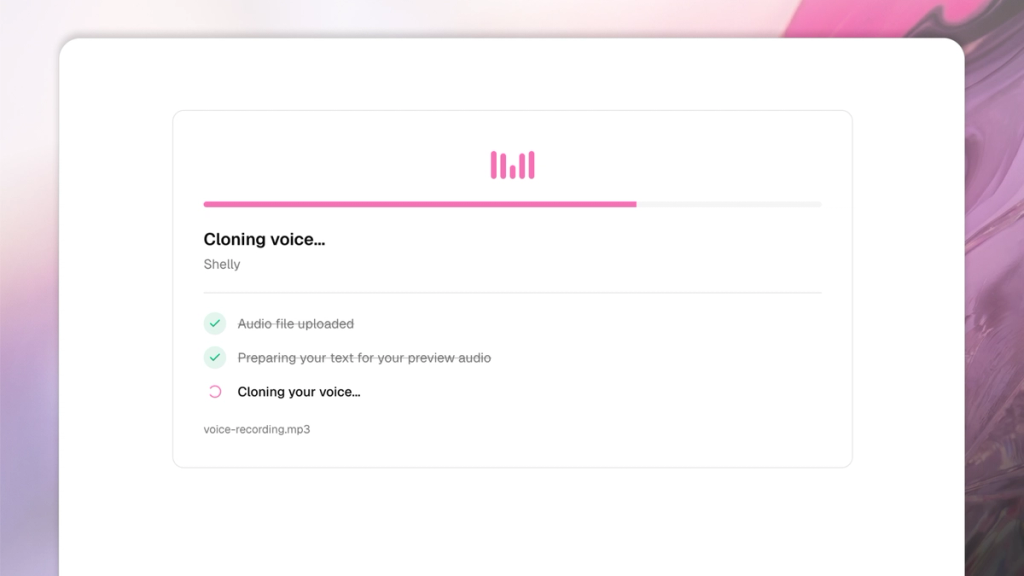
In SecretSauce, Voice Studio clones your voice from a short sample for text-to-speech voiceovers, so you can easily scale voiceover videos.
Disadvantages of a voice clone
- It's only as good as the sample: Background noise or a second speaker in the recording carries into every voiceover made from it, so record the sample somewhere quiet
- It needs the person's sign-off: You need to agree with the spokesperson how and where the clone will be used
- Only as natural as the script: A clone copies how a person sounds, and the words still come from the script
What is a recorded human voiceover?
A recorded human voiceover is a person reading the script into a microphone, whether that's a creator you've hired, a voice actor, or someone on your team. It's the option every AI voice is measured against.
Advantages of a recorded human voiceover
- Instinct: A good speaker stresses the right word and finds the pause on their own, even in a script that doesn't mark them
- Room to improvise: A person can fix a clumsy line on the spot
- Takes direction in plain words: You can ask for "warmer" or "like you're telling a friend" and hear the new take in the same session, without turning the note into settings
If someone on your team records the voiceover, these UGC tips on talking-head delivery help them get a natural read.
Disadvantages of a recorded human voiceover
- Every change is a new booking: A new hook, a new price, or a new market means booking time and recording again
- Consistency costs extra: Keeping one voice across a campaign means booking the same person for every ad
- It doesn't scale to testing: A team that wants 10 versions of a hook has to record 10 takes, or test fewer hooks
Which voiceover option fits your team
The right voiceover option for a UGC ad depends on what the ad is for and how often its script will change. Teams that test at volume feel the cost of recorded human voiceovers. Alinea, a US consumer fintech, has a paid social team that "tests between 30 and 40 new video ad concepts every week." Booking a recording for every concept would take 30 to 40 sessions a week, which is unrealistic and too expensive for most teams to keep up with.
- Choose a generic AI voice if you're testing formats and hooks, the ad doesn't need to sound like anyone in particular, and the script will change more than once a week
- Choose a voice clone if your ads need one recognizable voice, a founder's or a spokesperson's, and you'll make more of them than that person has time to record
- Choose a recorded human voiceover if the ad is a hero piece that will run for months, the script is final, and you have the budget to record it properly
How to write AI UGC scripts that don't sound like AI
Whichever option you choose, the voice reads the script exactly as it's written, so the script has to be written to be spoken from the start. If you generate a script from ChatGPT or Claude without much of a brief, it'll often come back with the disconnected fragments and flat lines from the opening example.
The simplest fix is a tool that writes the script and voices it in the same platform, from what it knows about your brand. In SecretSauce, the copywriting skill writes video scripts in your brand voice, and UGC video builds the ad, with every generation drawing on your Brand Brain.
If your team writes the script with AI anyway, or edits one by hand, rewrite it for the voice before anyone generates a read with the following tips:
1. Connect every fragment to the next thought
The biggest giveaway to AI written scripts are the short, disconnected fragments. Nobody says "No cap." and stops there, or announces "Change the color." as a sentence of its own. People run those words straight into the thought they belong to: "no cap, this is insane," or "ok, I'm just gonna change the color." Make sure to add small connecting words like "so," "and," and "but," which pick each line up from the one before it.
Go through the script and join every fragment to the thought it belongs to. "Launch day. No ad. Panic." becomes "We're launching Friday and we still don't have an ad, so I'm making one right now." The second version has a much more natural pace.
2. Give each beat its own emotion and pace
Usually, voiceovers are flat because each line in the script is read aloud with the same emotion. UGC ads have beats, and each one needs something different from the voice:
| Beat | What it does | How the voice should sound |
|---|---|---|
| Hook | Names the situation in the first seconds | Quick, a little urgent or curious |
| Setup | Says what's going wrong | Mild frustration |
| Reaction | The moment the person sees the product work | Slower, surprised |
| Payoff | Shows the result | Calm, then quiet, so the product can sit on screen |
Write the emotion next to each line in the script in brackets. The AI voice then gets a direction for every line instead of one tone for the whole ad. The reaction beat matters most, because surprise is where a person's voice changes, and a script that skips straight from setup to payoff leaves the voice nowhere to shift.
3. Write for the ear
AI voices say every word exactly as it's typed. Here are three habits that make a script sound more natural:
- Use contractions: "I didn't think this would work" sounds like a person, and "I did not think this would work" sounds like a press release
- Write numbers the way you'd say them: "twenty-nine dollars" in the voice script, and $29 in the on-screen text, so the voice can't stumble on a symbol
- Spell brand and product names for sound: If your product name could be read two ways, spell it in the voice script the way it should sound, and keep the real spelling on screen
4. Sprinkle in slang
Slang helps an AI UGC script sound like a real person, because it's how people actually talk when they're filming themselves for friends. Phrases like "lowkey" or "the audacity" puts the speaker in a specific moment, gives the voice a natural place to put its emphasis, and tells viewers the ad was made for people like them.
The balance is in how much. One or two slang phrases in a short ad set the tone, and an ad with none at all is fine too. Past that, or with slang dropped in only to sound young, the ad starts to sound cringe. Each phrase should carry a real thought or reaction from the person in the ad. Here are slang phrases we often use:
- "No cap"
- "It's giving [occasion]" (or "it's givinggg")
- "Main character"
- "Delulu is the solulu"
- "Soft launch"
- "Per my last message" (or "per my last text")
- "Need thisss"
- "No thoughts, just [thing]"
- "The audacity"
- "I can't believe it's free"
- "Lowkey" and "highkey"
- "Nothing fancy"
5. Use ad libs throughout
Ad libs are the short asides a person says without planning them, like "ok wait" or "okay but look at it." They make a read sound live, because they show the speaker reacting to what's in front of them instead of reciting a line. Use one ad lib per moment at most, and never stack them, because "ok wait, lowkey, okay but" in one breath sounds like the AI trying too hard. Fill in the blanks to fit your product:
| Hooks | Reactions | Choosing | Quick changes | Payoffs |
|---|---|---|---|---|
| "POV: payday is Friday and you have $12 left" | "Ok wait, these are actually cute" | "This one, obviously" | "Just change [name], [date], [one joke]" | "...and that's it" |
| "Day 12 of trying to drink more water" | "Ok wait, lowkeyyy, these are actually cute" | "Not too busy, not too basic" | "Make it yours" | "It's giving [occasion]" |
| "Things I wish I knew before my first winter with dry skin" | "Why are there this many options" | "The one that fits my story, not the prettiest" | "Swap the font, we're done" | "Send it" |
| "Pt [number]: [things] I can't believe are free" | "It's literally one search" | "Option B gets [emoji], option C gets [emoji]" | "Three edits, that's the whole job" | "Okay but look at it" |
| "Rating [products] for [situation]" | "Scrolling like it's a menu" | — | — | — |
| "Reply to [comment]" | — | — | — | — |
| "[Time]: realizes [problem]" | — | — | — | — |
AI voiceover options in UGC video tools
Before you generate anything, read the script out loud once, at the speed you'd say it to a friend. Every place you stumble, run out of breath, or hear a line nobody would say is a place the voice will sound like AI too.
However you compare AI voiceover options in UGC video tools, the voice can only sound as natural as the script it reads. Scripts with lines that connect, a different feel for each beat, a little slang, and an ad lib where the speaker would react, can ship without another round of edits, so your team spends its review time on the ideas.
SecretSauce writes the script in your brand voice, voices it in your cloned voice, and makes the UGC video in one place, with every generation drawing on your Brand Brain. Start my brand's first project.
People also ask
How do you compare AI voiceover options in UGC video tools?
Run one finished script through each option you're considering and listen to the reads side by side. Then weigh how human each one sounds against what a script change will cost your team, for the job this ad has to do.
Can you clone your voice for UGC ads?
Yes. A voice clone is made from a short recording of you talking, and it reads any new script in your voice, so you can voice a week of ad variations without recording each one. Record the sample somewhere quiet, with one speaker and no background noise, because anything in the sample carries into every voiceover. If the voice belongs to a founder or a creator, agree with them first on how and where the clone will be used. In SecretSauce, you can clone your voice in Voice Studio for text-to-speech voiceovers, and lip sync matches mouth movement to the new audio when the cloned voice goes onto video you already have.
What are the best AI features for enhancing UGC video quality?
The features that do the most are the ones that make the ad sound and read like a person: a voice clone for a natural read, captions for people watching with the sound off, and lip sync, which matches mouth movement to new audio, so a cloned or dubbed voice lines up with the video.
Do you need to disclose AI voiceover in ads?
It depends on the platform and the market, so check the rules for each one you run ads in before you publish. AI UGC for brands covers platform labels and disclosure. Whatever the rules require, never present an AI presenter as a real customer.