Brand memory: How to stop re-explaining your brand to AI

You open a new AI chat and paste your style guide. It's the umpteenth time you've had to explain your brand voice this month.
Multiply that by every teammate who's ever opened a new AI chat for your brand, and you end up with a pile of content that all sound a little different from each other.
The unfortunate cost of most AI tools is that they don't remember you between sessions. But brand memory here at SecretSauce fixes that gap. It's the standing context an AI tool carries forward automatically, so you stop re-briefing and start creating.
What you'll learn
- Persistent context means AI applies your voice, visuals, and rules without you re-explaining them each time.
- It replaces manual brand consistency software with tools that catch brand drift before you publish.
- Teams share one source of truth instead of juggling separate prompts and separate interpretations.
- Setup typically takes minutes. And the payoff grows with every asset you generate after.
What is brand memory in an AI content generator?
Brand memory is the persistent brand context an AI content generator like SecretSauce stores and reuses automatically. You never have to start from a blank prompt each time you open a new AI session.
Think of it like a standing brief with your voice, your visuals, your approved claims, all loaded before the first word gets written. No file to dig up or thread to re-read.
Most tools still work the opposite way. You paste your AI brand guidelines into a chat, get one usable draft out of it, and start from zero again next time.
Even after OpenAI raised the character limit for custom instructions in ChatGPT from 1,500 to 5,000 characters, that space fills up fast once your voice, banned words, and compliance rules are all competing for the same few thousand characters. This kind of persistent context removes the reset button entirely.
Brand memory with SecretSauce typically draws from a few core inputs:
- Your existing brand library of logos, colors, and product shots
- Style guides and tone documents you already have
- Past outputs you've approved, edited, or rejected
- Product facts and claims you're allowed to make publicly
Once that's in place, every new prompt checks against it before anything gets generated.
Say you ask for a product photo. Without memory, you'd re-describe your lighting style, your color palette, and your product angles from scratch. With brand memory, a tool like SecretSauce already knows, and the first draft looks like content you'd be proud to post.
What is a Brand Brain?
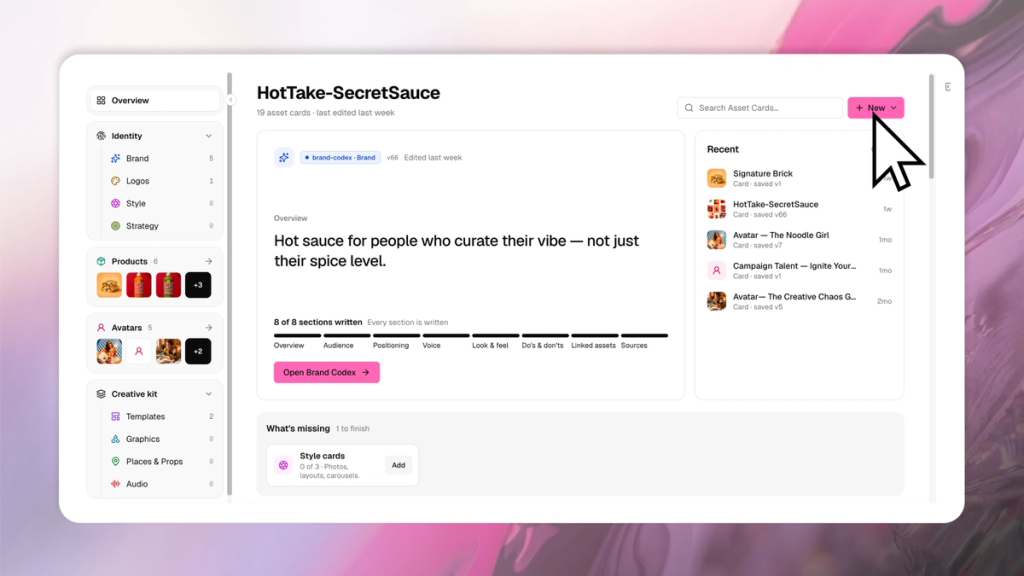
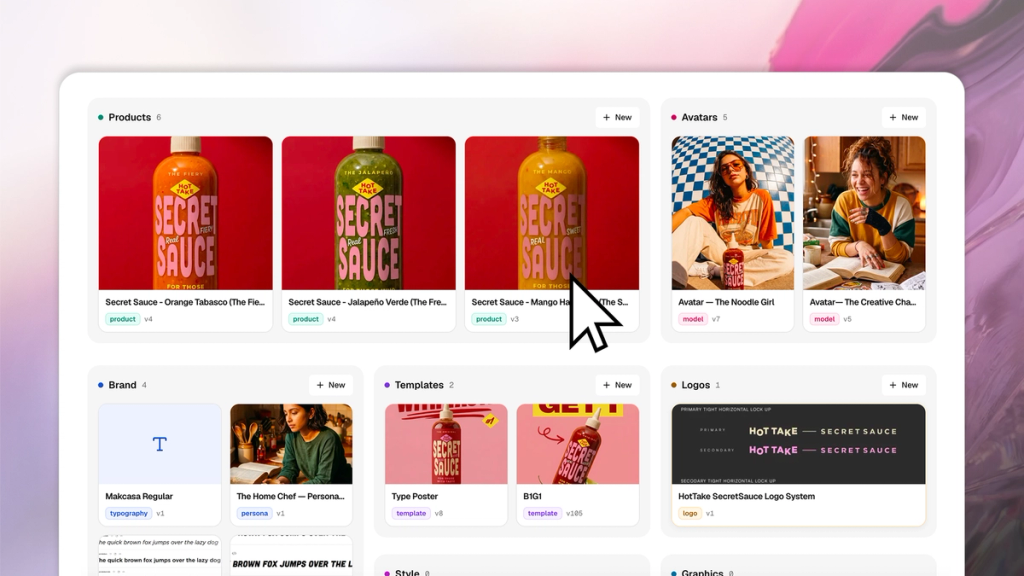
At SecretSauce, we call brand memory your Brand Brain. You set it up once, dropping in a URL, a style guide, or brand files, and every generation afterward checks against it.
It isn't a static document sitting in a shared folder somewhere. It's a living set of rules and reference materials that leverages logic to understand which rules to apply where, when. Each piece carries its own images alongside its own do's and don'ts, so your product knows how big it should look, your photography style knows what lighting to hold, and your logo knows where it's allowed to sit. For example, if you want a product video for your Instagram, its logic will call all the different photography styles, colors, products, and more needed to construct the video.
How AI brand memory replaces brand consistency software
Traditional brand consistency software works after the fact. Someone creates content then someone else checks it against the guidelines, usually in a separate review pass.
That review step is exactly where mistakes slip through, especially on tight deadlines when nobody has time for a second look. Most brand consistency software on the market still works exactly this way, checking after the fact instead of before.
That's fine when volume is low, but it falls apart the moment you're publishing daily. It also explains a gap Marq's State of Brand Consistency research keeps finding: 85% of organizations have brand guidelines, but only 30% enforce them consistently.
A memory-based approach flips the order entirely:
- Rules apply before content gets created, not after
- Drift gets flagged automatically, without a manual audit
- Everyone works from the same context, so review becomes a formality instead of a bottleneck
This matters most because a generic AI tool has no idea what "on-brand" even means for you specifically. It produces competent, forgettable output, and you spend the time you saved cleaning it up instead. A brand management platform built around persistent memory skips that cleanup step entirely.
Brand governance across a team
Brand governance gets harder as your team grows. More people means more interpretations of "casual but professional," and more room for drift to creep in unnoticed.
Shared brand memory gives everyone the same standing context to work from:
- One Brand Brain, one source of truth for the whole team
- Freelancers and new hires produce on-brand work starting on day one
- No more re-explaining tone in a group chat for the tenth time this quarter
Disorder Media used exactly this setup to keep creative consistent while scaling production across dozens of campaigns. They did so without having a heavier review layer to slow things down.
Brand asset management without the overhead
Manual brand asset management means someone keeps the logo folder current, the style guide updated, and the banned-words list circulated to whoever needs it. It's tedious work, and it's usually the first thing that slips when a team gets busy.
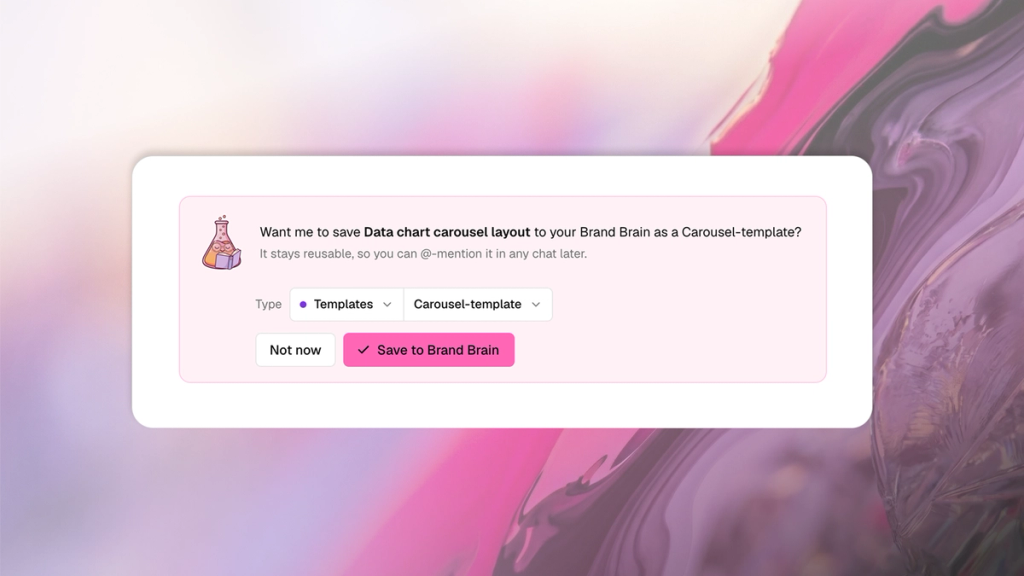
A memory layer stays current automatically instead. Update your Brand Brain once, and every future generation reflects the change immediately with no re-distribution required.
For example, Borderless Butter found this setup saves time that used to go entirely into manual upkeep and version-checking.
A quick brand consistency checklist
Not sure your current setup actually supports brand consistency? Run through this checklist before you touch another AI tool:
- Voice and tone rules are written down, not just understood by one person
- Banned words and phrases are listed explicitly, not left to memory
- Approved product claims are spelled out in plain language
- Visual identity (colors, fonts, logo use) is documented in an accessible, shared location.
- Compliance or legal restrictions are flagged clearly for every asset type
- A few example outputs show what "on-brand" actually looks like in practice
Missing more than two of these? Start there. Everything downstream, including how well an AI tool can actually use your brand, depends on it.
FAQ
How is brand memory different from just writing a good prompt?
A good prompt works once, for one output. Brand memory works every time, across every session, without a rewrite. A prompt disappears when the session ends, but brand memory is already loaded before you type a word.
Can I use brand memory with my team?
Yes. A shared Brand Brain means your whole team, including freelancers and contractors, pulls from the same context instead of separate briefs that drift apart over time. Check our pricing for team plans, or enterprise for larger rollouts with more seats and tighter controls.
What if my output doesn't look on-brand?
Flag it. This kind of memory improves as you correct outputs, so mistakes become training signal instead of just extra rework. Our frequently asked questions page covers troubleshooting specifics in more depth.
Do I need to re-upload my brand every time?
No. That's the entire point of the system. Set it up once and it persists across every project, every campaign, and every teammate you add later.
Brand consistency without the re-brief
Brand consistency stops being a manual chore once your AI tool actually remembers what your brand sounds and looks like. That's what separates tools you can trust from ones you have to double-check line by line, every single time.
You didn't hire an agency to re-explain your brand in every single meeting. Your AI shouldn't need that either.
Browse our case studies to see what real teams have built with this, or set up your own Brand Brain today.