14 UGC hook structures that stop the scroll for your brand
Your viewer gives you about a second before they swipe to the next post. How can you earn their trust in a handful of seconds so your product gets its moment?
Most brands borrow video hooks from whatever's trending. The catch is that a hook that stops the scroll but doesn't sound like you can cost more than it earns. People stop, feel the mismatch and keep scrolling.
Below are 14 structures of UGC hooks you can steal, plus how long a hook should run and how to keep each one on-brand.
Key takeaways
- A hook is the first 1 to 3 seconds of a video, and it decides whether anyone sees the rest.
- Keep hooks to one line or visual beat, and test one at a time.
- The best social media hooks still sound like your brand.
- Below are 14 hook structures, each with a fill-in formula and an example.
What is a hook in a UGC video?
A hook in a UGC video is the opening line, visual or on-screen text in the first 1 to 3 seconds of a creator-style clip. Its job is to stop someone mid-scroll long enough to hear what's next. If the hook misses, the rest of the video doesn't get watched.
Hooks come in three forms, and the strongest UGC hooks often stack two of them:
- Spoken: the first sentence out of the creator's mouth.
- Visual: movement, a close-up or something that looks off.
- Text: an on-screen line for people watching with the sound off.
OpusClip analyzed 34,635 TikTok clips from early 2026 and found the top hook type averaged roughly twice the views of the lowest-ranked one. The winner showed the product or the outcome in the first two seconds. Video hooks that spent their opening on a slow story setup ranked last.
14 UGC hooks that stop the scroll
Each comes with a formula and a quick script. Treat them as UGC video examples to rework for your product.
| Hook | Formula | Type |
|---|---|---|
| Nice catch | [Your product] comes flying in. Catch it, review it. | Visual hook |
| Tease | Extreme close-up then zoom out to reveal | Visual hook |
| Chaos reset | Chaos then calm | Visual hook |
| Oops reveal | Bump into the camera, apologize, show the product | Visual hook |
| Epic fail | Stunt fails | Visual hook |
| Random mic | Spatula, hairbrush, banana … | Visual hook |
| Glow up | Before and after | Visual hook |
| Grand entrance | Walk into an empty scene | Visual hook |
| Mythbuster | "Stop [habit] if you want [result]" | Spoken hook |
| Story open | Start mid-action, skip the intro | Spoken hook |
| Result first | Show the "after," then rewind | Visual hook |
| Call out | "If you run a [business], this is for you" | Spoken hook |
| Objection voice | Say the viewer's doubt first | Spoken hook |
| POV | "POV: you finally [win]" | Written hook |
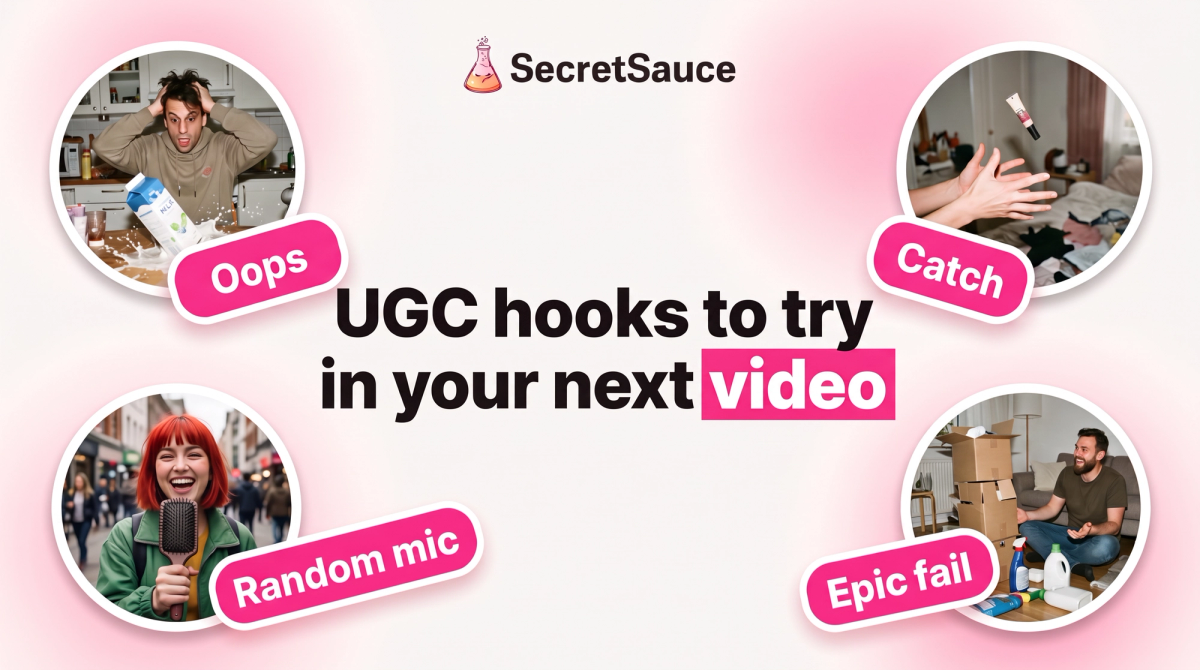
1. Nice catch
Formula: Your product gets tossed into frame from off-screen. They catch it, and the review starts right there.
Example: A skincare brand's serum flies in from the side. The founder catches it one-handed without looking, already mid-sentence: "Okay so this is the one everyone's been asking about."
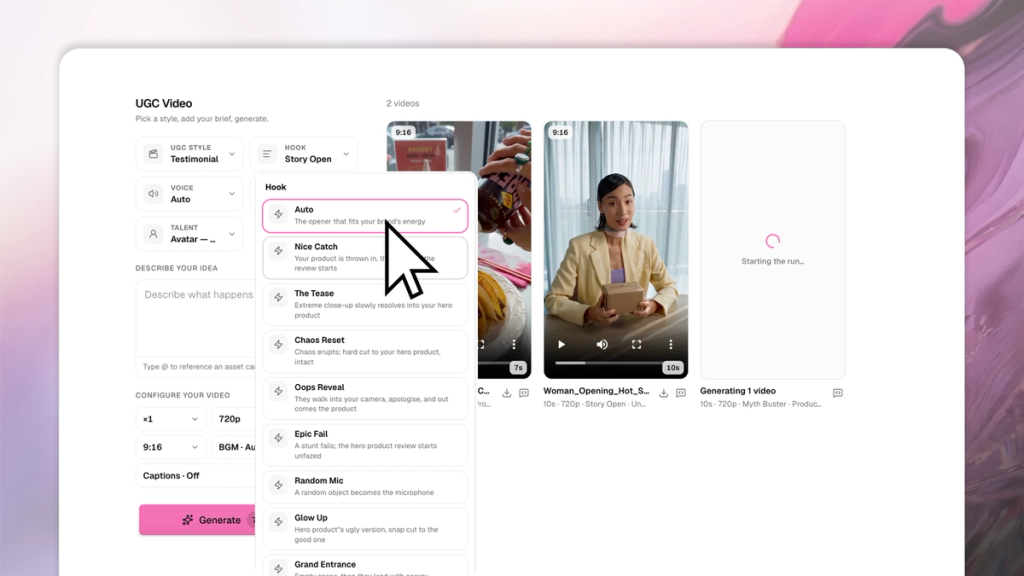
This one comes off as effortless because nobody braces for the catch or reaches out early. Skip it for anything heavy, fragile, or open on top, since the throw stops working the second it looks risky. This visual hook is built into SecretSauce's UGC Video Studio.
2. Tease
Formula: Open tight on a texture nobody can figure out. Pull back slowly until the product resolves into view.
Example: A close-up of ridged glass fills the frame for a second before the camera eases back to reveal a candle jar.
The whole hook depends on the first frame hiding what it is. If a viewer can identify the product before the pull-back lands, the tease never happens. People stay for the reveal because withheld information is its own hook. The slower the pull-back, the more it feels like the camera is building toward something, even on a product shot. This is also a built-in SecretSauce hook.
3. Chaos reset
Formula: Something chaotic tears through the frame, then one hard cut brings everything back exactly as it was.
Example: A desk is buried in wind-blown papers for a second, then cuts clean to the same desk, spotless, with the planner sitting untouched in the middle.
The product has to survive the chaos completely still and completely unharmed for the cut to land. It's not a before-and-after or a cleanup, it's one scene interrupted and then restored. The appeal is relief, not chaos. Viewers brace for damage, so the untouched product lands as a small, satisfying surprise, almost like a magic trick.
4. Oops reveal
Formula: Shoot it from the viewer's point of view walking down the street. Bump the camera, apologize, and the product comes out of the bump.
Example: Someone walks into frame, there's a blur and a thud, they laugh and say "sorry, sorry" straight to camera, then hold up the bag they almost dropped.
This is the one hook built around a real reaction, so let the apology land before moving on. It only works bumping the camera itself, never another person in the shot. The bump works like a real interruption, which is exactly why it doesn't feel like an ad. Nobody scripts getting caught off guard, so it borrows credibility from looking unplanned. You can also select this hook as a preset in the SecretSauce UGC Video Studio.
5. Epic fail
Formula: Attempt something confidently, let it fail in a way that's funny and not painful, then start the actual review completely unbothered.
Example: Someone tries to flip a pancake, it lands on the floor, and without missing a beat they turn to camera: "Anyway, this pan is the only reason I still try."
It's best if the fail doesn't get a reaction, not a laugh, not a glance at the camera. The silence around it is what makes it funny. Keep it to one line after the fail if the clip runs short. People can't look away from something about to go wrong, and that's the whole engine here. The fail buys you the first two seconds for free. The unfazed pivot right after is what turns rubbernecking into actually watching the review. Choose it as a preset hook in SecretSauce.
6. Random mic
Formula: While already mid-sentence, a random object falls into frame and becomes the microphone.
Example: Someone's explaining a skincare routine when a hairbrush drops into their hand from above. They keep talking into it without pausing.
The object has to be genuinely random, never the product, never branded. The moment it becomes expected, it stops being funny. It works on sheer absurdity: nobody expects a spatula to become a microphone, so the brain stays on the clip a beat longer just to see where it's going.
7. Glow up
Formula: Show an honest, unflattering before. Cut hard to the after, same framing, with the product as the reason for the change.
Example: A stained, worn cutting board, then one snap cut to it looking brand new after a single wash with the product.
The before has to be real, not exaggerated and never a competitor's product standing in for it. One plain line of verdict after the cut is enough. Don't oversell it. This one taps into the same pull as a transformation story. Viewers want to see the gap close, and the snap cut compresses the proof into a single second instead of asking them to trust a claim.
8. Grand entrance
Formula: Hold on an empty, deliberately framed scene for a beat. Then someone lands in it with energy.
Example: An empty kitchen counter holds for a second before someone slides into frame holding the product like they just won something.
This one needs the energy to be real, so it's a poor fit for a brand that needs to be calm or understated. Don't speak until the landing is finished. The empty beat before the landing is like a drumroll. It tells the viewer something's about to happen, which is a cheap, reliable way to earn their attention before you've said a thing.
9. Mythbuster
Formula: "Stop [common habit] if you want [result]."
Example: A restaurant owner says, "Stop shooting your menu under kitchen lights."
Ads rarely open by telling you you're doing something wrong, so this one jolts people. It's also a built-in hook in SecretSauce's Video Studio. The myth has to be one people actually believe, not a scolding in disguise. If the line sounds like you're calling the viewer out, it's not a mythbuster. If the opener promises a turn, the clip has to show it. A hook like "I owe the gravy an apology" only works if the scene plays out the doubt and the change of mind, not just the finished dish.
10. Story open
Formula: Start in the middle of the moment. Skip "hey guys" and skip the setup.
Example: An Airbnb host, mid-unpack: "So a guest left a review about our photos…"
OpusClip's data shows slow story setups underperform, so drop the viewer straight into the action. It's another built-in Video Studio hook. Pair the mid-action start with one visual cue that signals the topic (the product, the setting) so viewers don't get confused.
11. Result first
Formula: "[Outcome] in [timeframe]. Here's how."
Example: A skincare founder says, "Three weeks, zero filters," then rewinds to day one. Hold the result for a beat, one to two seconds, then cut to the rewind. Linger any longer and the hook turns into the video.
Leading with the outcome lines up with what OpusClip found works best on TikTok. You'll spot this structure in a lot of UGC ad examples when you browse competitors' ads in SecretSauce's Creative Radar.
12. Call out
Formula: "If you run a [type of business], this one's for you."
Example: "If you run a bakery and post the same croissant photo every week, this one's for you."
Naming the viewer makes them feel seen, and it filters out people who'll never buy. That's why call-out social media hooks work so well for small shops with a tight local audience. The narrower the category, the harder it hits. 'If you run a business' flatters nobody. 'If you run a bakery and post the same croissant photo every week' makes the right person feel caught.
13. Objection
Formula: "I thought [doubt]. Then [surprise]."
Example: "I thought AI product photos always looked fake. Then I tried it on my own jar."
Saying the doubt first takes the fight out of it. It's also a strong answer to the question founders ask most: can't I do this with a generic AI tool? Pull the doubt from something real: a comment, a DM, a review, not a guess at what people might think.
14. POV
Formula: "POV: you finally [relatable win]."
Example: "POV: you finally have a week of posts ready before Monday."
POV openers are native to TikTok and Reels, so they read like content instead of an ad. Keep the win small and specific enough to believe. One more thing: POV is one of the most copied formats on the platform right now, which means a generic one disappears into a sea of identical openers. It only works when the win is specific enough that someone else couldn't claim it as their own.
How long should a UGC ad hook be?
A UGC ad hook should land within 1 to 3 seconds. In practice, that's a single line or a single visual beat. If you need a second sentence to make the point, the hook is too long.
Pace matters as much as length. Looking at real creator ads next to early AI-written scripts, the creator ads ran 3.0 to 3.6 words per second and the AI versions ran closer to 2.2. Hooks that are technically short can still feel slow if it's spoken that much more deliberately than a real person talks.
| Platform | What to lead with | Watch out for |
|---|---|---|
| TikTok | A spoken line or fast motion | Slow intros |
| Instagram Reel hooks | On-screen text and a strong first frame | Text hidden behind the caption |
| Facebook feed | A visual that works on mute | Hooks that rely on audio |
Instagram hooks can look more polished than TikTok's, but the timing rule is the same.
SecretSauce's Video Studio makes UGC clips of up to 10 seconds, so the opening has to earn its place fast. Add subtitles so your first line still lands with the sound off.
If you're running paid, test one hook at a time. Keep the body footage identical and swap only the opener. That way you'll know which video hooks are pulling their weight.
Why your best hooks still need to sound like you
A borrowed hook can win the stop and still lose the sale. If the first line sounds like a different brand, viewers notice.
That's brand drift, and it's why your brand's voice has to show up from the first second.
Most AI tools forget who you are between sessions, so every new batch of UGC hooks starts from scratch. SecretSauce's Brand Brain learns your brand once from your website or brand docs. It then applies that memory to every hook and to the UGC videos it generates.
The result is social media hooks that stop the scroll and still sound like you wrote them.
A few phrases give away an AI-written hook faster than anything else: "stop scrolling," "you NEED this," "obsessed," "game changer," "10/10." A one-word rhetorical question like "Honestly?" is another. Cut them even if they feel punchy, and never invent a confession, a number, or a commenter just to create curiosity. A staged detail isn't a real testimonial, and viewers can tell.
UGC hooks FAQ
What is an example of a hook?
A simple example is "Stop shooting your menu under the kitchen lights," spoken in the first second of a restaurant's video. A visual example is olive oil hitting a pan in slow motion before anyone speaks. Both give viewers a reason to stay without naming the brand.
What are some viral TikTok hooks?
Two of the most copied openers are "POV: you finally…" and "Stop doing [X] if you want [Y]." The versions that keep performing show the product or result fast, which matches OpusClip's 2026 findings.
What's UGC on TikTok?
UGC on TikTok is creator-style content about a product, filmed to look like a real person's post. Brands run it organically and as paid ads. The person on camera can be a real customer or an AI avatar built for your brand.
What is a hook in social media terms?
In social media terms, a hook is whatever stops the scroll at the very start of a post. On video, it's the first line or frame. On a carousel, it's the first slide. Good social media hooks make the next part feel worth the swipe.
What exactly is a viral hook?
A viral hook is an opening format that spreads because people recognize it and remix it, like "POV:" or "Things I'd never buy again." Viral video hooks get attention, but copying the exact words makes you sound like everyone else. Borrow the structure and write the line in your own voice.
What are some good hook ideas?
Start with the 14 structures above. A couple of UGC ideas to try: a host opening on the messiest room before the reveal, or a skincare brand answering its most common objection on camera. Rotate your openers every few weeks so they don't go stale.
Pick a hook, then make it yours
Pick one structure, write a few versions in your own words and test them against the same footage. Strong UGC hooks and video hooks earn the stop, but social media hooks that sound like you are what earn the sale.
Try SecretSauce's UGC Video Studio to start experimenting with these hooks.